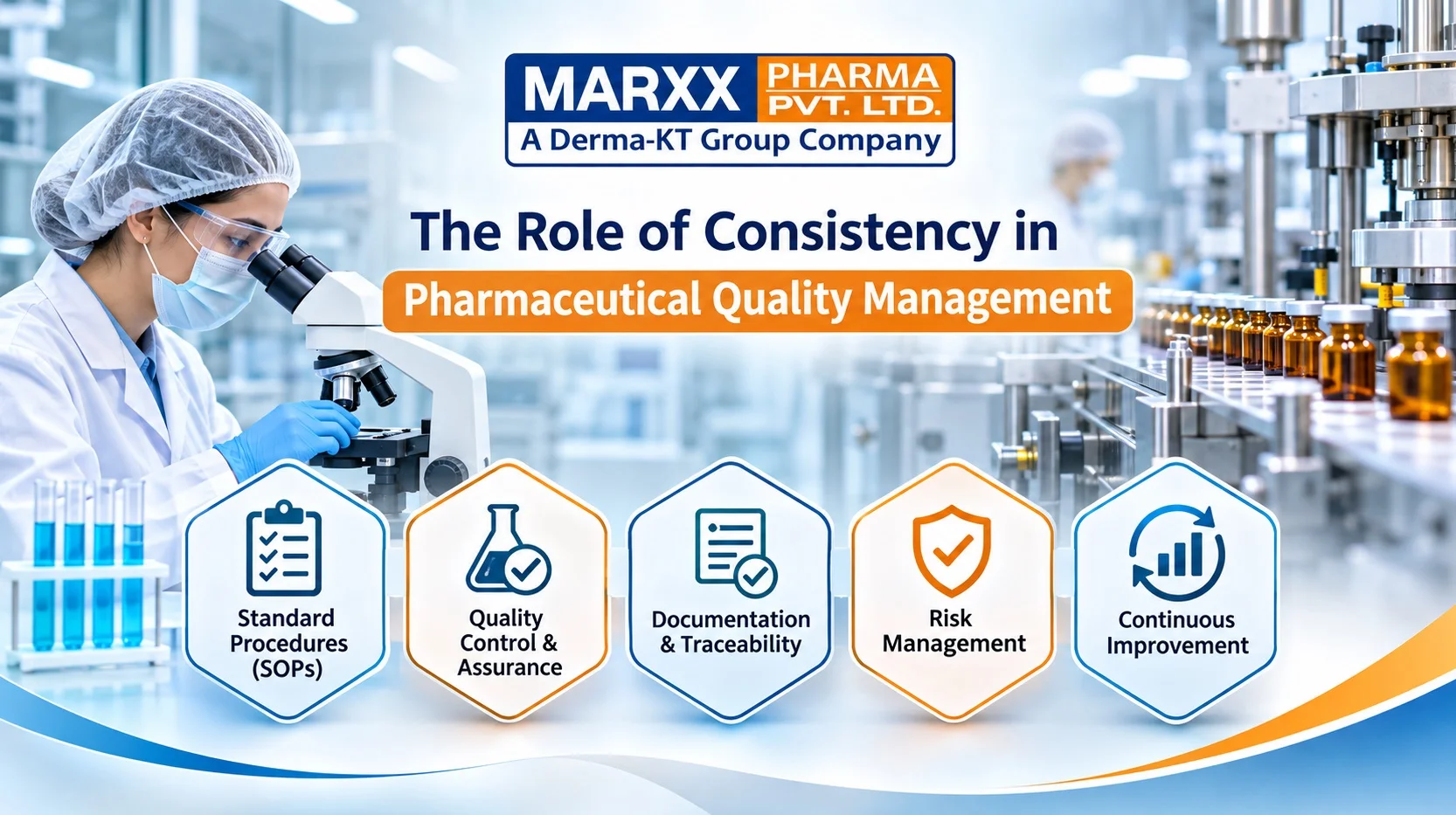
In the pharmaceutical industry, quality is not defined by a single successful product or one satisfactory inspection. It is built through processes that are carefully established, consistently followed, regularly evaluated and continuously improved.
Every stage of a pharmaceutical product's lifecycle involves important quality considerations. Product development, sourcing, manufacturing, testing, packaging, storage and distribution all require appropriate controls. A weakness in one area can affect the overall quality system.
This is why consistency in pharmaceutical quality management matters.
Consistency helps organisations establish predictable processes, maintain reliable documentation, identify deviations and make informed decisions. It also supports a culture in which quality is treated as an ongoing responsibility rather than a final checkpoint.
For pharmaceutical companies such as Marxx Pharma Pvt. Ltd., understanding the importance of consistent quality practices is relevant to building professional credibility and supporting responsible participation in the healthcare industry.
What Is Consistency in Pharmaceutical Quality Management?
Consistency in pharmaceutical quality management means applying approved procedures, quality requirements and control measures in a systematic and repeatable manner.
It involves ensuring that people, processes, documentation and monitoring activities work together towards defined quality objectives.
For example, a quality-focused operation should not depend on an employee remembering an informal instruction or following a different process each time. Activities should be supported by documented procedures, appropriate training, defined responsibilities and suitable records.
Consistency can be reflected in several areas:
- Following approved Standard Operating Procedures (SOPs).
- Maintaining accurate and complete documentation.
- Applying appropriate quality checks.
- Monitoring processes and product quality.
- Managing deviations through defined procedures.
- Reviewing corrective and preventive actions.
- Controlling changes to established processes.
- Training employees according to their responsibilities.
In simple terms, consistency means that quality expectations are understood and applied across the organisation, not just during audits or inspections.
Why Is Consistency Important in the Pharmaceutical Industry?
Pharmaceutical products are closely connected to patient health and public confidence. As a result, the industry requires structured quality systems and responsible operational practices.
Consistency supports these objectives in several important ways.
1. Supports Reliable Product Quality
A pharmaceutical quality system should help ensure that products meet their established specifications and quality requirements.
When applicable processes are properly defined and consistently followed, organisations can better monitor variations and identify potential problems.
For example, where manufacturing activities are involved, consistent controls may apply to:
- Raw material assessment.
- Production procedures.
- In-process checks.
- Laboratory testing.
- Packaging operations.
- Finished product evaluation.
- Storage and handling.
These activities must be appropriate to the product, process and applicable regulatory requirements.
Consistency does not mean assuming that every batch or process will be identical without monitoring. It means having suitable controls to understand, evaluate and manage variation.
2. Strengthens Quality Assurance and Quality Control
Quality Assurance (QA) and Quality Control (QC) are important parts of pharmaceutical quality management, but they serve different purposes.
Quality Assurance focuses on the systems and processes designed to provide confidence that quality requirements are being met.
Quality Control focuses on activities such as sampling, testing and inspection used to evaluate whether materials and products meet established specifications.
Consistency helps both functions work effectively.
For example, quality assurance depends on approved procedures, employee training and systematic reviews. Quality control depends on appropriate sampling plans, validated or otherwise suitable analytical methods, defined acceptance criteria and accurate reporting.
When these activities are coordinated, organisations have a stronger foundation for identifying and addressing quality concerns.
3. Improves Documentation and Traceability
Documentation is essential to pharmaceutical quality management.
A quality-related activity should be supported by records that accurately show what was done, when it was done, who was responsible and what the outcome was.
Consistent documentation helps organisations:
- Trace relevant activities and decisions.
- Review historical records.
- Investigate deviations.
- Identify recurring issues.
- Demonstrate that procedures were followed.
- Support internal and external audits.
- Maintain accountability.
For example, if an unexpected quality issue occurs, complete and accurate records can help teams investigate the circumstances and identify possible causes.
Poor documentation, on the other hand, can make it difficult to understand what happened and whether appropriate controls were applied.
A strong documentation culture treats records as evidence of the work performed, not merely paperwork to complete.
4. Helps Reduce Process Variability
Variability can occur at different stages of pharmaceutical operations. It may relate to materials, equipment, environmental conditions, people, procedures or process parameters.
Not every variation automatically represents a quality failure. However, unexplained or uncontrolled variation deserves attention.
Consistent procedures and monitoring help organisations recognise unusual patterns and investigate them appropriately.
A structured approach may include:
- Defining relevant process parameters.
- Establishing suitable acceptance criteria.
- Monitoring performance trends.
- Investigating unexpected results.
- Evaluating the impact of changes.
- Taking appropriate corrective action.
The objective is not simply to eliminate every difference. It is to maintain processes in a controlled state and ensure that quality requirements continue to be met.
5. Supports Regulatory Compliance
Pharmaceutical businesses operate within regulatory frameworks that establish expectations for product quality, documentation, manufacturing practices and other relevant activities.
Good Manufacturing Practices (GMP) provide important principles for controlling pharmaceutical manufacturing and related operations.
Consistency supports compliance by helping organisations apply approved procedures, maintain records, train personnel and manage quality-related activities systematically.
However, it is important to understand that quality management certification and pharmaceutical regulatory compliance are not interchangeable.
For example, ISO 9001 is a general quality management system standard. GMP requirements are specific to regulated pharmaceutical activities. An organisation should evaluate the standards and regulatory requirements that apply to its actual operations and products.
A consistent quality system helps make compliance part of everyday operations rather than an activity performed only before an inspection.
The Key Elements That Build Consistency in Pharmaceutical Quality Management
Consistency does not happen automatically. It requires an organised framework supported by leadership, people, processes and continuous evaluation.
The following elements play an important role.
1. Standard Operating Procedures (SOPs)
SOPs provide documented instructions for carrying out defined activities.
They help employees understand how a task should be performed and what requirements must be followed.
Effective SOP management includes:
- Clear instructions and responsibilities.
- Appropriate approval before implementation.
- Version control.
- Employee training.
- Periodic review.
- Controlled revision when processes change.
SOPs should reflect actual approved practices. A procedure that exists only on paper but is not followed does not create operational consistency.
2. Employee Training and Awareness
Employees influence the effectiveness of a quality management system every day.
Even well-designed procedures can fail when responsibilities are unclear or personnel are not adequately trained.
Regular training helps employees understand:
- Their responsibilities within the quality system.
- Applicable procedures and work instructions.
- Documentation requirements.
- How to report deviations.
- Relevant hygiene and safety practices.
- The importance of following approved processes.
Training should be appropriate to the employee's role and supported by suitable records and effectiveness checks.
A strong quality culture encourages employees to raise concerns instead of ignoring or hiding potential problems.
3. Effective Quality Documentation
A consistent documentation system provides visibility into operational activities and supports accountability.
Relevant records may include:
- SOPs and work instructions.
- Training records.
- Material and supplier documentation.
- Batch-related records, where applicable.
- Equipment maintenance records.
- Testing and inspection records.
- Deviation reports.
- Change control documentation.
- Corrective and preventive action records.
Documentation practices should follow applicable requirements for accuracy, completeness, review, retention and data integrity.
4. Deviation Management and CAPA
A deviation occurs when an activity or result does not follow an approved procedure or established requirement.
A deviation should be documented, assessed and investigated according to its nature and potential impact.
Corrective and Preventive Action (CAPA) is an important quality management mechanism.
- Corrective action addresses the cause of an identified problem.
- Preventive action aims to reduce the likelihood of potential problems.
An effective CAPA process should go beyond fixing the immediate issue. It should examine the underlying cause and evaluate whether the action taken has been effective.
Repeated problems may indicate that an existing process, training programme or control measure needs improvement.
5. Change Control
Consistency does not mean that processes should never change.
Pharmaceutical operations must evolve when new information, technology, regulatory expectations or business requirements emerge.
However, changes should be evaluated and controlled.
A change management process typically involves:
- Recording the proposed change.
- Assessing its potential impact.
- Obtaining appropriate review and approval.
- Implementing the approved change.
- Updating relevant documents and training.
- Reviewing the outcome where appropriate.
Controlled change helps organisations improve processes without introducing unnecessary quality risks.
6. Quality Risk Management
Quality risk management helps organisations identify, evaluate and control potential risks that may affect product quality.
Instead of treating every issue in the same way, risk-based thinking helps prioritise activities according to their potential impact.
For example, a change that could affect a critical product quality attribute may require a more detailed assessment than a minor administrative update.
ICH Q9 provides guidance on quality risk management, while ICH Q10 describes a broader pharmaceutical quality system framework.
Together, these approaches support more informed quality decisions and systematic process control.
The Role of ICH Q10 in Pharmaceutical Quality Management
The International Council for Harmonisation (ICH) Q10 guideline describes a model for an effective Pharmaceutical Quality System (PQS).
It is designed to support pharmaceutical quality throughout the product lifecycle, including development, technology transfer, commercial manufacturing and product discontinuation.
ICH Q10 identifies three important objectives:
1. Achieve product realisation
Establish systems that support the delivery of products with appropriate quality attributes.
2. Establish and maintain a state of control
Monitor process performance and product quality to maintain suitable and capable processes.
3. Facilitate continual improvement
Identify opportunities to improve products, processes and the pharmaceutical quality system.
The framework also highlights the importance of knowledge management and quality risk management.
For pharmaceutical organisations, this reinforces an important principle: quality should be managed through a connected system rather than isolated checks.
How Consistency Supports Long-Term Business Credibility
Quality management is not only an operational responsibility. It also influences how a pharmaceutical organisation is viewed by distributors, business associates, healthcare professionals and other stakeholders.
Consistent practices can support business credibility in several ways.
Builds Professional Confidence
Organisations that maintain clear procedures and reliable records are better positioned to explain how quality-related responsibilities are managed.
Supports Better Coordination
Defined processes and responsibilities can improve communication between departments, suppliers and business partners.
Strengthens Operational Planning
Monitoring and reviewing processes can help organisations identify recurring issues and make more informed operational decisions.
Encourages Continuous Improvement
Consistent measurement and review make it easier to identify areas where procedures, training or controls may need attention.
Supports Responsible Business Relationships
Partners benefit from clear product information, transparent communication and well-defined responsibilities.
Long-term credibility is developed through repeatable actions and accountability, not through quality statements alone.
Common Challenges That Affect Consistency in Pharmaceutical Quality Management
Even organisations with established quality systems may face challenges in maintaining consistency.
Some common examples include:
ChallengePotential ImpactImprovement ApproachOutdated SOPsEmployees may follow incorrect proceduresRegular document review and version controlInadequate trainingInconsistent execution of activitiesRole-based training and effectiveness checksIncomplete recordsReduced traceabilityStrong documentation practicesUncontrolled changesUnexpected process variationFormal change controlRepeated deviationsRecurring quality concernsRoot cause analysis and effective CAPAWeak communicationDelayed identification of issuesDefined reporting and escalation channelsLimited process monitoringProblems may remain unnoticedAppropriate performance and quality monitoring
Addressing these challenges requires management commitment, employee participation and regular evaluation of the quality system.
How Pharmaceutical Companies Can Build a Culture of Consistency
A sustainable quality culture develops when quality expectations are understood and supported throughout the organisation.
Pharmaceutical companies can strengthen this culture through practical steps:
- Make quality responsibilities clear at every organisational level.
- Maintain current and approved procedures.
- Provide regular, role-specific employee training.
- Encourage accurate and timely documentation.
- Investigate deviations instead of treating them as routine paperwork.
- Evaluate changes before implementation.
- Review quality performance using relevant data.
- Encourage communication between departments.
- Use audit findings and feedback to identify improvement opportunities.
- Make continual improvement part of management discussions.
Most importantly, leadership should demonstrate that quality is a shared organisational responsibility.
When employees understand why procedures matter, consistency becomes part of the working culture rather than simply a compliance requirement.
Marxx Pharma Pvt. Ltd. and the Importance of Quality-Focused Business Practices
Marxx Pharma Pvt. Ltd. is an Indian pharmaceutical and healthcare company based in Hisar, Haryana.
The company's journey dates back to 2010, while Marxx Pharma Pvt. Ltd. was incorporated on 17 December 2022. Its official company profile references ISO 9001:2015 certification and a portfolio of more than 400 products across categories that include allopathic, Ayurvedic, cosmetic and nutraceutical segments.
Its broader product portfolio includes areas such as pain management, anti-infectives, respiratory care, gastroenterology, vitamins and supplements, dermatology and personal care.
For a pharmaceutical business operating across diverse healthcare categories, quality awareness, clear product information, responsible business practices and effective coordination are important considerations.
The wider pharmaceutical industry continues to evolve through changing customer expectations, regulatory developments and improvements in quality management practices.
Marxx Pharma's company and product portfolio can be explored through its official website.
Explore Marxx Pharma:
Explore Company Divisions:
https://marxxpharma.com/divisions/
Frequently Asked Questions (FAQs)
1. Why is consistency important in pharmaceutical quality management?
Consistency helps pharmaceutical organisations apply approved procedures, maintain accurate documentation, monitor process performance and manage quality risks. It supports controlled operations and helps ensure that established quality requirements are addressed systematically.
2. What is a Pharmaceutical Quality Management System?
A Pharmaceutical Quality Management System is a structured framework of policies, procedures, responsibilities and monitoring activities designed to manage quality throughout relevant stages of a pharmaceutical product's lifecycle.
3. How do SOPs improve pharmaceutical quality?
Standard Operating Procedures provide approved instructions for performing specific activities. They help employees follow defined processes, reduce avoidable variation and maintain consistent documentation.
4. What is the role of CAPA in pharmaceutical quality management?
CAPA stands for Corrective and Preventive Action. It helps organisations investigate quality issues, address underlying causes and reduce the likelihood of similar problems occurring again.
5. What is ICH Q10 in the pharmaceutical industry?
ICH Q10 is an internationally harmonised guideline describing a model Pharmaceutical Quality System. It focuses on product realisation, maintaining process control and continual improvement throughout the product lifecycle.
6. What is the difference between Quality Assurance and Quality Control?
Quality Assurance focuses on the systems and processes designed to support quality requirements. Quality Control involves activities such as sampling, testing and inspection to assess whether materials or products meet established specifications.
7. How does documentation support pharmaceutical quality?
Documentation provides evidence of activities, decisions and results. It supports traceability, investigations, audits, accountability and effective quality management.
8. Does consistency mean pharmaceutical processes should never change?
No. Consistency means that processes are controlled and changes are evaluated, approved, documented and implemented appropriately. Continuous improvement is an essential part of an effective quality system.
9. What is the relationship between GMP and quality management?
Good Manufacturing Practices establish important requirements and principles for pharmaceutical manufacturing and related operations. A Pharmaceutical Quality System provides a broader management framework for maintaining and improving quality.
10. How can a pharmaceutical company improve its quality culture?
A company can strengthen its quality culture through management commitment, employee training, clear SOPs, accurate documentation, risk-based decisions, effective deviation management and continuous improvement.
Important Quality Management Perspective
Consistency is not about repeating the same actions without thinking. It is about ensuring that the right processes are followed, monitored and improved in a controlled manner.