
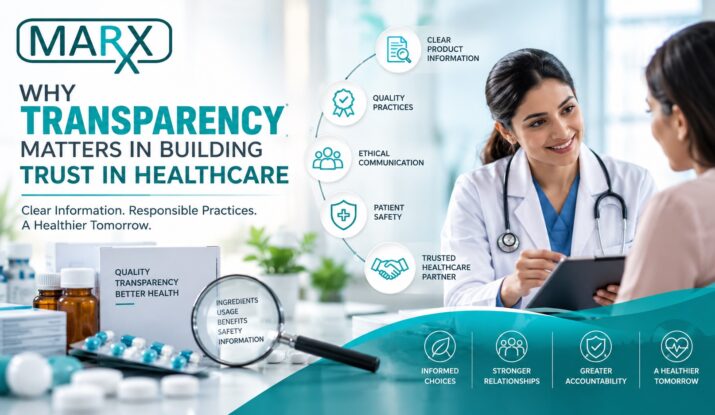
Why Transparency Matters in Building Trust in Healthcare
Healthcare is built on trust. People trust healthcare professionals to guide their decisions, pharmaceutical companies to communicate responsibly, and healthcare systems to prioritise quality and patient wellbeing.
But trust does not develop through promises alone. It grows when information is clear, expectations are realistic and organisations demonstrate accountability through their actions.
This is why transparency in healthcare matters. Whether a person is reviewing a medicine label, researching a healthcare company or seeking guidance about a health concern, access to reliable information can make the decision-making process more informed.
For pharmaceutical companies, transparency extends beyond marketing. It includes responsible product communication, appropriate quality practices, accurate claims and a willingness to explain what a product does—and what it cannot promise.
At Marxx Pharma Pvt. Ltd., the broader conversation about healthcare trust highlights an important industry principle: sustainable relationships begin with clear information and responsible practices.
In this article, we explore why transparency is essential in healthcare, how it influences patient and consumer confidence, and what pharmaceutical organisations can do to strengthen trust.
What Is Transparency in Healthcare?
Transparency in healthcare means communicating relevant information clearly, accurately and responsibly so that people can better understand their options and make informed decisions.
It involves more than sharing information. The information must also be understandable, appropriately supported and presented without misleading omissions or exaggerated claims.
In the pharmaceutical industry, healthcare transparency can include:
- Clear product descriptions and intended uses.
- Accurate ingredient information and appropriate labelling.
- Honest communication about benefits, limitations and potential risks.
- Responsible advertising and evidence-based claims.
- Clear information about quality processes and applicable standards.
- Accessible channels for product enquiries and feedback.
- Respect for patient privacy and the responsible handling of personal information.
Transparency does not mean disclosing confidential business information or personal health data. It means providing the right information to the right audience in a responsible and understandable way.
Why Does Transparency Matter in Healthcare?
Transparency helps reduce confusion, supports informed choices and creates a stronger foundation for accountability. Its importance can be understood through five key areas.
1. Transparency Builds Patient and Consumer Confidence
Healthcare decisions can feel complicated. People may encounter unfamiliar medical terminology, multiple product options and conflicting information online.
Clear communication helps make these decisions easier to understand.
When healthcare organisations explain products accurately, provide accessible information and avoid unrealistic promises, people have a better opportunity to assess their options.
For pharmaceutical companies, this means ensuring that product communication is informative rather than misleading. A clear explanation of a product’s intended use is more valuable than a broad claim that cannot be substantiated.
Confidence grows when people can understand the information presented to them and know where to seek clarification.
2. Clear Product Information Supports Informed Decisions
Product information plays a significant role in healthcare decision-making.
Consumers and healthcare professionals may need to understand a product’s ingredients, intended use, directions, warnings, storage requirements and other relevant details.
Incomplete or confusing information can lead to misunderstandings. Clear labelling and responsible communication help people interpret product information more appropriately.
For pharmaceutical organisations, this requires attention to the accuracy and consistency of information across packaging, websites, product literature and promotional materials.
Digital content deserves particular care. A product description should not imply that a medicine treats a condition, guarantees results or is suitable for everyone unless the relevant claim is appropriately supported and permitted.
The principle is straightforward: useful healthcare information should clarify decisions, not create unrealistic expectations.
3. Transparency Strengthens Quality and Accountability
Trust depends not only on what an organisation says, but also on the processes behind its work.
In the pharmaceutical industry, quality-related responsibilities may include documentation, supplier oversight, applicable manufacturing standards, product traceability and procedures for addressing quality concerns. The precise requirements depend on the organisation’s role and the products involved.
Transparent communication about quality practices can help stakeholders understand how an organisation approaches its responsibilities.
However, claims about certification, testing or compliance must be specific and accurate. A quality management certification should not be presented as automatic proof that every product is clinically effective or free from risk.
For example, ISO 9001:2015 concerns quality management systems. It does not replace product-specific regulatory requirements, clinical evidence or applicable pharmaceutical manufacturing standards.
For a healthcare company, accountability means being precise about what its quality systems establish—and avoiding claims that go beyond the available evidence.
4. Honest Communication Helps Manage Expectations
Healthcare products are not one-size-fits-all solutions. Their suitability and outcomes may depend on the product, its intended use and individual circumstances.
Responsible communication acknowledges these differences.
This is especially important in marketing. Claims such as “guaranteed results,” “zero risk” or “works for everyone” can create expectations that healthcare products may not be able to meet.
A more responsible approach explains the intended purpose of a product, provides relevant directions and avoids implying that a product can replace professional medical advice when it cannot.
Honest communication is not a limitation on brand building. It is a way to build relationships around realistic expectations.
Over time, clear and balanced information can contribute to a more credible brand reputation than exaggerated claims.
5. Transparency Encourages Better Healthcare Awareness
Reliable healthcare information can help people ask better questions, recognise misinformation and understand when professional guidance is necessary.
Educational content from pharmaceutical and healthcare organisations can contribute to this process when it is accurate, accessible and appropriately qualified.
Examples include explaining how to read product labels, describing the difference between medicines and supplements, clarifying safe storage practices, and helping readers understand when to consult a qualified healthcare professional.
Healthcare education should not replace diagnosis or treatment advice. Its role is to support understanding and encourage responsible decisions.
For pharmaceutical companies, investing in useful educational content can create value beyond product promotion. It can help people navigate healthcare information with greater confidence.
The Role of Transparency in the Pharmaceutical Industry
Pharmaceutical companies operate in an environment where product quality, regulatory compliance and responsible communication are essential.
Transparency supports these responsibilities in several practical ways.
Accurate Product Communication
Product descriptions, packaging information and promotional content should be consistent with approved product information and applicable requirements.
Claims about ingredients, benefits, intended use and safety should be appropriately supported.
Responsible Marketing
Marketing should communicate product information clearly without overstating benefits or minimising relevant limitations.
This is particularly important for products associated with pain relief, nutrition, skincare, wellness and other areas where consumers may encounter strong promotional claims.
Quality-Related Communication
Companies should describe their quality systems, certifications and processes accurately. Where a claim depends on specific testing, certification or regulatory approval, the supporting documentation should be available and current.
Stakeholder Communication
Distributors, retailers, healthcare professionals and other partners benefit from consistent product information and clear communication channels.
Feedback and Accountability
A transparent organisation should have appropriate ways to receive questions, record concerns and route quality-related issues to the relevant team.
Together, these practices can support a more accountable pharmaceutical environment.
How Digital Transparency Is Changing Healthcare
Digital platforms have changed how people research healthcare products and organisations.
Consumers may discover a brand through a search engine, read a company website, compare product information or ask an AI assistant to explain a health-related topic. Each interaction can influence their understanding of the organisation.
This creates new responsibilities for healthcare businesses.
Make Official Information Easy to Find
Company websites should provide accessible company details, product categories, contact information and relevant product information.
Information should be kept current, and outdated claims should be reviewed rather than left online indefinitely.
Write for People, Not Just Search Engines
Healthcare content should answer real questions in plain language. Short paragraphs, descriptive headings and direct explanations make information easier to understand.
Search optimisation should improve access to accurate information—not encourage keyword repetition or unsupported claims.
Support Claims With Relevant Evidence
Where content makes factual claims about ingredients, certifications, clinical outcomes or product performance, the supporting evidence should be appropriate to the claim.
References to recognised standards and credible healthcare sources can help readers evaluate information more effectively.
Keep AI-Readable Content Accurate
AI-powered search systems may summarise information from company websites and other sources. Clear definitions, consistent company details and well-structured FAQs can make content easier to interpret.
However, no content format guarantees inclusion or ranking in AI-generated answers. Accuracy, usefulness and consistency should remain the priorities.
What Can Healthcare Companies Do to Improve Transparency?
Transparency becomes meaningful when it is built into everyday business practices. Healthcare organisations can strengthen their approach through the following steps.
1. Review product information regularly. Check descriptions, labels, website content and promotional material for accuracy and consistency.
2. Use evidence-based claims. Ensure that statements about product benefits, quality and performance are supported by appropriate documentation.
3. Explain technical information clearly. Use accessible language without removing important warnings, qualifications or context.
4. Communicate limitations responsibly. Avoid guarantees and absolute claims that cannot be justified.
5. Provide clear contact channels. Make it easy for customers and business partners to ask questions or raise concerns.
6. Protect personal information. Handle health-related and other personal data in accordance with applicable privacy requirements.
7. Establish feedback processes. Ensure relevant enquiries and quality concerns reach the appropriate team and are handled through documented procedures.
8. Review digital content. Remove outdated information and update content when product details or applicable requirements change.
These actions can help turn transparency from a marketing message into an organisational practice.
Marxx Pharma Pvt. Ltd.: The Importance of Responsible Healthcare Communication
Marxx Pharma Pvt. Ltd. operates within India’s pharmaceutical and healthcare landscape, with a portfolio that the company presents across multiple product categories.
For pharmaceutical organisations, trust is supported by a combination of responsible product communication, appropriate quality management and clear information for customers and business partners.
A company’s website can play a useful role by helping visitors explore its products, understand its business and locate relevant information.
Marxx Pharma’s official product portfolio provides a starting point for learning more about its offerings.
Explore the Marxx Pharma product portfolio.
As healthcare expectations continue to evolve, clear and responsible communication remains relevant to every organisation seeking to build long-term relationships in the sector.
The broader lesson is that trust should not be treated as a slogan. It must be supported by the quality of information an organisation shares, the accuracy of its claims and the way it responds to questions and concerns.
The Business Value of Transparency
Transparency is often discussed as an ethical responsibility, but it also has practical business value.
When people can find clear and consistent information, they may spend less time resolving basic questions and have a better understanding of a company’s offerings.
For business partners, reliable communication can support smoother coordination and reduce avoidable misunderstandings.
For healthcare brands, transparent communication can also help distinguish useful information from promotional exaggeration.
The benefits are not automatic. Transparency must be supported by accurate information, consistent processes and appropriate follow-through. A public statement about quality or trust has little value if the organisation’s actions do not support it.
In this sense, transparency is not simply a communication strategy. It is part of how a responsible healthcare business operates.
Looking Ahead: Building a More Trustworthy Healthcare Environment
The future of healthcare will be shaped by scientific progress, digital transformation, changing consumer expectations and the growing volume of health information available online.
As access to information expands, the need for clear, credible communication will become even more important.
Healthcare organisations that prioritise transparency can help people understand products more accurately, ask more informed questions and recognise the importance of professional guidance.
For pharmaceutical companies, the path forward involves more than presenting information attractively. It requires ensuring that information is accurate, relevant, appropriately supported and accessible to the people who need it.
Trust develops through repeated experiences. Each clear product description, responsible claim, useful answer and appropriately handled concern can contribute to that process.
Frequently Asked Questions About Transparency in Healthcare
1. What is transparency in healthcare?
Transparency in healthcare means providing clear, accurate and relevant information about healthcare services, products, quality practices and potential risks so people can make more informed decisions.
2. Why is transparency important in the pharmaceutical industry?
Transparency helps people understand product information, supports responsible marketing, improves accountability and encourages trust between pharmaceutical companies, healthcare professionals, customers and business partners.
3. How does transparency improve patient trust?
Clear information can reduce confusion and help people understand available options, product directions and limitations. Trust is strengthened when communication is consistent with an organisation’s actions.
4. What does pharmaceutical transparency include?
It can include accurate product descriptions, appropriate labelling, evidence-supported claims, clear communication about quality practices, accessible enquiry channels and responsible handling of feedback.
5. How can healthcare companies demonstrate transparency online?
Healthcare companies can publish clear company and product information, review content regularly, provide accessible contact details, use appropriate references and avoid misleading or unsupported claims.
6. Does ISO 9001:2015 certification prove that a medicine is effective?
No. ISO 9001:2015 concerns quality management systems. It does not, by itself, prove the clinical effectiveness or safety of an individual medicine or replace applicable product-specific requirements.
7. What role does transparency play in healthcare marketing?
Transparent healthcare marketing presents product information accurately, avoids exaggerated claims and helps audiences understand a product’s intended use and limitations.
8. How can consumers evaluate healthcare information?
Consumers can review official product information, check whether claims are supported by credible evidence, consult qualified healthcare professionals when necessary and be cautious of guaranteed outcomes or claims that seem too good to be true.
Why Choose Marxx Pharma?
Marxx Pharma focuses on delivering healthcare and wellness solutions with an emphasis on quality and customer needs.
Key Reasons to Consider Marxx Pharma
- Diverse healthcare product portfolio
- Pharmaceutical and wellness solutions
- Nutraceutical product range
- Ayurvedic healthcare options
- Personal care products
- Focus on quality and affordability
- Healthcare solutions for different lifestyle requirements
The company’s approach is centered on making healthcare and wellness products more accessible to consumers.
Contact Details
Marxx Pharma Pvt. Ltd.
Plot No. 177–178, Opp. Guru Jambheshwar University
Vikas Nagar, Hisar, Haryana – 125001
Landline: 01662-253000
Mobile: +91 98125-84000