How Strong Distribution Networks Support Healthcare Access
Healthcare accessibility depends on more than hospitals, doctors and medical technology. It also depends on something that often receives less public attention: the ability to deliver essential medicines and healthcare products reliably to the places where people need them.
A patient may receive the right diagnosis and prescription, but treatment can become difficult if the prescribed medicine is unavailable nearby. A pharmacy may be ready to serve its customers, but inconsistent supply can interrupt its ability to meet local demand.
This is where strong pharmaceutical distribution networks make a meaningful difference.
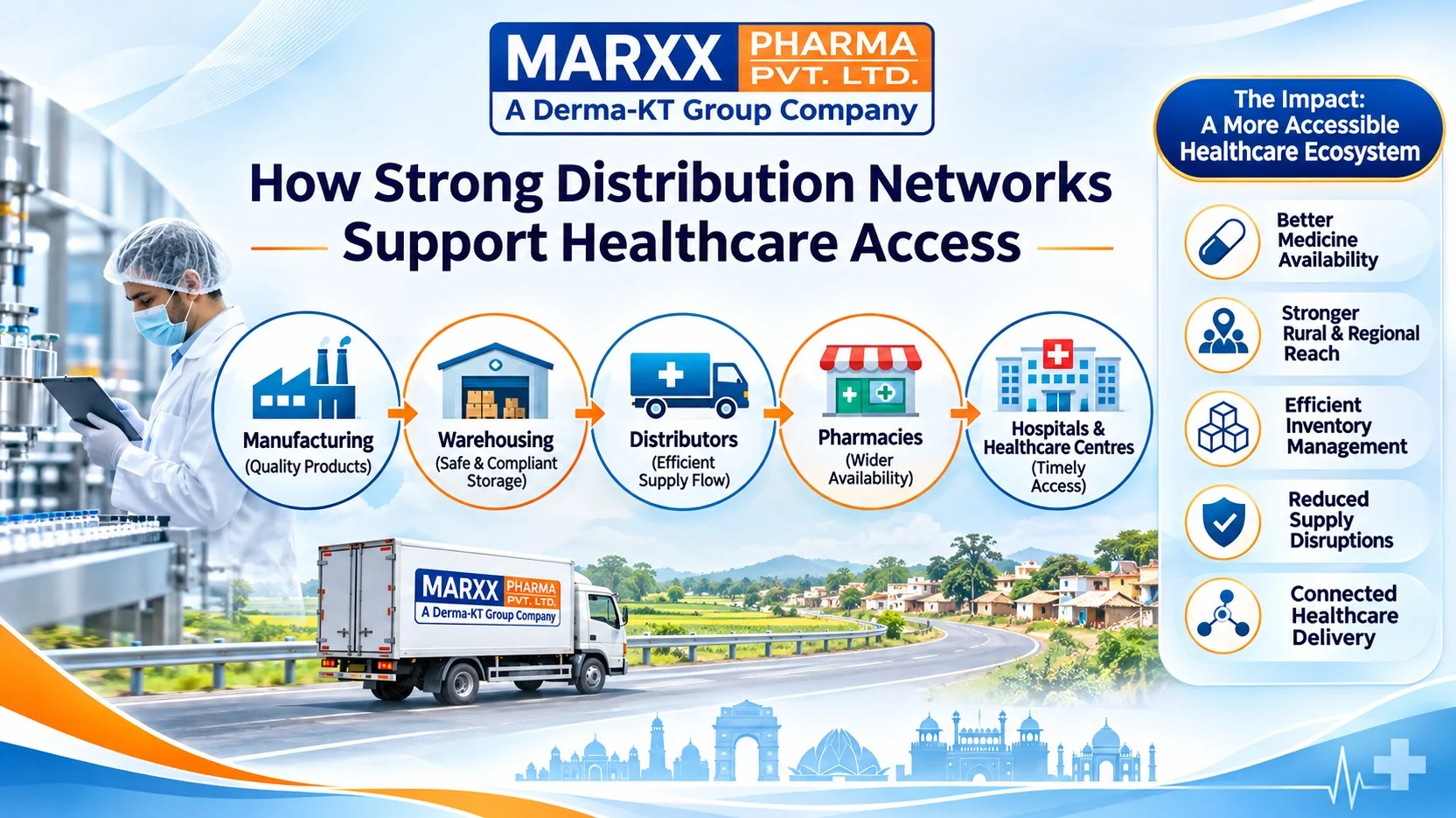
In India's diverse healthcare landscape, distribution connects pharmaceutical manufacturers with distributors, stockists, pharmacies, hospitals and ultimately patients. A well-organised network helps improve product availability, reduce supply disruptions and support healthcare delivery across urban as well as underserved regions.
Strong pharmaceutical distribution networks are not simply about moving products. They are about connecting healthcare supply with real patient needs.
What Is a Pharmaceutical Distribution Network?
A pharmaceutical distribution network is the organised system through which medicines and healthcare products move from manufacturers to the businesses and institutions that make them available to patients.
It generally involves several participants:
- Pharmaceutical manufacturers.
- Carrying and forwarding agents.
- Super-stockists and distributors.
- Wholesale medicine suppliers.
- Retail pharmacies.
- Hospitals and healthcare institutions.
- Logistics and transportation partners.
Each participant has a specific responsibility in maintaining the movement, storage and availability of pharmaceutical products.
An effective distribution network coordinates these activities through inventory planning, order management, transportation, documentation and communication.
The objective is to ensure that the right products reach the right destinations while maintaining applicable quality, storage and regulatory requirements.
Why Distribution Networks Matter for Healthcare Access
The strength of a healthcare system is influenced by how effectively it connects patients with the services and products they need.
Distribution networks support this connection in several important ways.
1. Improving Medicine Availability
Medicine availability is one of the most direct ways distribution affects healthcare access.
Pharmacies and healthcare institutions need dependable supplies to meet the requirements of their communities. When distribution systems function efficiently, businesses can replenish inventory and respond more effectively to customer demand.
Reliable availability can help reduce avoidable delays caused by supply interruptions.
For pharmaceutical companies, this requires coordination with distributors, accurate order processing and a clear understanding of market requirements.
2. Connecting Rural and Urban Healthcare Markets
India has significant geographical and demographic diversity. Healthcare requirements in a metropolitan city may differ from those in a smaller town or rural community.
Urban locations often have more established commercial and healthcare infrastructure. Smaller towns and remote areas may face challenges related to transportation, storage, distributor coverage and access to suppliers.
A well-developed pharmaceutical distribution network can help bridge some of these gaps.
It can support:
- Better distributor coverage across different regions.
- More organised supply to smaller towns.
- Improved coordination with local pharmacies.
- Greater visibility into regional product demand.
- More efficient replenishment planning.
Distribution cannot solve every healthcare infrastructure challenge, but it can make the medicine supply system more connected and responsive.
3. Reducing Supply Disruptions
Unexpected supply interruptions can affect pharmacies, hospitals and patients.
Disruptions may result from transportation delays, inaccurate demand forecasting, inventory shortages, manufacturing constraints or communication gaps.
A strong distribution network helps businesses identify and manage these risks through:
- Regular inventory monitoring.
- Multiple distribution points where appropriate.
- Better demand forecasting.
- Supplier coordination.
- Timely order tracking.
- Clear communication between channel partners.
The goal is not simply to move products faster. It is to build a supply system that can respond to changing conditions without compromising product quality.
4. Supporting Better Inventory Management
Inventory management plays an important role in pharmaceutical distribution.
Excess inventory can increase storage requirements and the risk of products reaching their expiry dates. Insufficient inventory can lead to stock shortages and missed supply opportunities.
A balanced inventory strategy helps distributors and pharmacies manage both risks.
Important practices include:
- Monitoring stock levels regularly.
- Tracking batch numbers and expiry dates.
- Using demand forecasts for replenishment.
- Following first-expiry-first-out practices.
- Maintaining accurate purchase and sales records.
- Monitoring slow-moving and fast-moving products.
Digital inventory systems can make these processes more transparent and easier to manage.
5. Strengthening Product Traceability
Pharmaceutical products require careful handling and documentation throughout the supply chain.
Batch identification, expiry monitoring, purchase records and distribution documentation help businesses maintain traceability.
These processes are important for managing product quality, investigating complaints and supporting applicable recall procedures.
Where required, suitable temperature monitoring and controlled storage conditions are also essential.
A reliable distribution network recognises that product quality must be maintained beyond the manufacturing facility.
The Role of Pharmaceutical Logistics in Reliable Healthcare Delivery
Pharmaceutical logistics involves the planning and management of product storage, handling, transportation and delivery.
Unlike ordinary consumer goods, medicines may have specific storage, handling and transportation requirements.
Logistics partners must therefore understand the nature of the products they transport.
Key Elements of Pharmaceutical Logistics
1. Appropriate Storage Facilities
Warehouses and storage locations should meet the applicable conditions specified for the products being handled.
2. Transportation Planning
Delivery routes, transportation partners and shipment schedules should be organised to support timely and appropriate product movement.
3. Temperature Management
Products that require temperature-controlled storage or transportation need suitable monitoring and handling arrangements.
4. Documentation and Traceability
Accurate records help businesses track product movement, batches, stock levels and delivery information.
5. Regulatory Compliance
Distribution activities must follow applicable pharmaceutical regulations, licensing requirements and good distribution practices.
These elements help protect product integrity and support a more dependable supply chain.
Major Challenges in Pharmaceutical Distribution in India
Although India's pharmaceutical industry has an extensive manufacturing and distribution ecosystem, several challenges can affect the efficiency of medicine distribution.
1. Geographical Barriers
India's varied geography creates different transportation and distribution requirements.
Remote villages, hilly regions and areas with limited infrastructure can be more difficult to serve consistently.
Businesses may need region-specific distribution strategies to improve coverage.
2. Inconsistent Demand Forecasting
Demand for pharmaceutical products can change due to seasonal conditions, local healthcare requirements, prescribing patterns and market developments.
Inaccurate forecasting may result in excess stock or shortages.
Better sales data, distributor feedback and inventory analytics can help improve planning.
3. Storage and Handling Requirements
Some pharmaceutical products require specific storage conditions.
Inadequate storage facilities, transportation practices or monitoring can create risks for product quality.
Companies and channel partners must understand and follow the applicable requirements for every product category.
4. Fragmented Supply-Chain Communication
Manufacturers, distributors, stockists and pharmacies may operate through different systems and processes.
When information is not shared effectively, order delays, inaccurate stock records and communication gaps can occur.
Digital integration and standardised operating procedures can improve coordination.
5. Working Capital and Inventory Pressure
Distributors and stockists need sufficient working capital to maintain inventory and manage business operations.
Delayed payments, excess inventory and slow-moving products can affect their ability to replenish stock.
Transparent commercial processes and better inventory planning can support stronger distribution partnerships.
How Technology Is Transforming Pharmaceutical Distribution
Technology is helping pharmaceutical businesses improve supply-chain visibility, operational efficiency and inventory control.
Digital systems can provide better information about product movement, order status and regional demand.
1. Inventory Management Software
Inventory management systems help businesses monitor stock quantities, batches, expiry dates and product movement.
This can reduce manual errors and support better replenishment decisions.
2. Real-Time Order Tracking
Order tracking systems allow businesses to monitor order processing, dispatch and delivery status.
Better visibility helps manufacturers and distributors respond to delays more effectively.
3. Data-Driven Demand Forecasting
Historical sales, seasonal patterns and distributor feedback can be analysed to estimate future demand.
Although forecasts cannot eliminate uncertainty, they can help businesses plan inventory more intelligently.
4. Digital Documentation
Digital records can improve access to invoices, purchase orders, delivery documents and stock information.
Well-managed documentation also supports business transparency and audit readiness.
5. Integrated Distribution Platforms
Connecting manufacturers, distributors and stockists through integrated platforms can improve communication and reduce repetitive manual work.
The long-term opportunity is to build a more connected pharmaceutical supply chain in which information moves as efficiently as products.
How Strong Distribution Networks Benefit Patients and Healthcare Providers
An efficient pharmaceutical distribution system creates value across the healthcare ecosystem.
For Patients
- Better access to medicines through local pharmacies.
- Reduced inconvenience caused by avoidable stock shortages.
- Improved availability across different locations.
- Greater confidence in an organised medicine supply system.
For Pharmacies
- More organised inventory replenishment.
- Better communication with suppliers.
- Improved stock and expiry management.
- More predictable order coordination.
For Hospitals and Healthcare Institutions
- Better coordination of medicine procurement.
- Improved inventory visibility.
- More structured supplier relationships.
- Greater support for continuity of healthcare services.
For Pharmaceutical Companies
- Stronger market connectivity.
- Better understanding of regional demand.
- Improved coordination with channel partners.
- More effective product availability planning.
- Long-term business relationships.
A distribution network creates the greatest value when every participant understands their responsibilities and works towards reliable product availability.
The Importance of Responsible Distribution Partnerships
A pharmaceutical distribution network is only as dependable as the relationships and processes that support it.
Manufacturers and distributors need to work together with clear expectations, transparent communication and a shared commitment to product quality.
Strong partnerships should focus on:
Regulatory responsibility: All participants should follow applicable licensing, storage, documentation and distribution requirements.
Business transparency: Commercial terms, order processes and responsibilities should be clearly communicated.
Product quality: Appropriate handling and storage practices should be maintained throughout the supply chain.
Market understanding: Distributor feedback can help manufacturers understand regional requirements and changing demand.
Long-term collaboration: Sustainable distribution relationships are built through reliability, communication and mutual trust.
The most effective distribution networks are not built overnight. They develop through consistent operational performance and responsible partnerships.
Marxx Pharma Pvt. Ltd. and the Importance of a Connected Healthcare Ecosystem
Marxx Pharma Pvt. Ltd. is an Indian pharmaceutical and healthcare company based in Hisar, Haryana.
The company's journey dates back to 2010, and Marxx Pharma Pvt. Ltd. was incorporated on 17 December 2022. According to its official website, the company is ISO 9001:2015 certified and offers a portfolio of more than 400 products across categories that include allopathic pharmaceuticals, Ayurvedic products, cosmetics and nutraceuticals.
Its product portfolio covers several healthcare segments, including:
- Pain management.
- Anti-infective products.
- Respiratory care.
- Gastroenterology.
- Vitamins and nutritional supplements.
- Dermatology and skin care.
- Eye, ear and nasal care.
- Other healthcare categories.
For pharmaceutical businesses, a diverse product portfolio makes effective supply-chain coordination particularly important.
Different products may have different storage, handling, demand and distribution requirements. Managing these requirements calls for organised processes and coordination across the pharmaceutical ecosystem.
As India's healthcare requirements continue to evolve, reliable distribution and responsible business partnerships remain important considerations for companies operating in the pharmaceutical sector.
Learn more about Marxx Pharma Pvt. Ltd. and its product portfolio:
Official Website: https://marxxpharma.com/
Company Divisions: https://marxxpharma.com/divisions/
Building the Future of Pharmaceutical Distribution in India
The future of pharmaceutical distribution will depend on how effectively businesses combine operational discipline, technology and responsible partnerships.
Several developments can help strengthen the sector:
- Wider regional distribution coverage: Improving connections with smaller towns and underserved markets.
- Digital supply-chain management: Using technology for order tracking, inventory monitoring and documentation.
- Better demand forecasting: Using reliable sales and market information to plan stock requirements.
- Improved logistics infrastructure: Strengthening warehousing, transportation and handling capabilities.
- Stronger distributor relationships: Building transparent and dependable business partnerships.
- Quality-focused operations: Maintaining appropriate storage, handling and traceability practices.
- Responsible market expansion: Growing distribution networks while meeting regulatory and operational requirements.
These developments can help create a pharmaceutical supply chain that is more responsive to market needs and better connected to healthcare delivery.
Frequently Asked Questions (FAQs)
1. What is a pharmaceutical distribution network?
A pharmaceutical distribution network is the system through which medicines move from manufacturers to distributors, stockists, pharmacies, hospitals and other authorised healthcare channels.
2. How do distribution networks improve healthcare access?
They help improve medicine availability, connect different regions with suppliers, support inventory replenishment and reduce avoidable supply interruptions.
3. Why is pharmaceutical distribution important in India?
India has a large and geographically diverse population. Effective pharmaceutical distribution helps connect manufacturers with healthcare providers and pharmacies across urban, semi-urban and rural markets.
4. What are the major challenges in pharmaceutical distribution?
Common challenges include transportation delays, geographical barriers, inventory shortages, demand forecasting difficulties, storage requirements, working capital pressure and fragmented communication.
5. How does technology improve medicine distribution?
Digital inventory systems, order tracking, demand forecasting and electronic documentation can improve supply-chain visibility, coordination and operational efficiency.
6. What is the role of distributors in the pharmaceutical industry?
Distributors connect pharmaceutical manufacturers with stockists, pharmacies and healthcare institutions. They help manage product movement, inventory replenishment and regional supply coordination.
7. Why is inventory management important in pharmaceutical distribution?
Effective inventory management helps reduce stock shortages, monitor expiry dates, improve replenishment planning and support appropriate product storage.
8. What is pharmaceutical traceability?
Pharmaceutical traceability involves maintaining records that help identify and track products through the supply chain, including relevant batch, expiry and distribution information.
9. How can pharmaceutical companies strengthen distribution partnerships?
They can strengthen partnerships through transparent communication, reliable order management, clear commercial processes, regulatory compliance and consistent coordination with channel partners.
10. How does Marxx Pharma Pvt. Ltd. participate in India's pharmaceutical sector?
Marxx Pharma Pvt. Ltd. operates in India's pharmaceutical and healthcare sector with a portfolio spanning allopathic pharmaceuticals, Ayurvedic products, cosmetics and nutraceuticals. Its official website provides details about its products and company divisions.
Reliable Distribution Is an Essential Part of Accessible Healthcare
Healthcare access depends on a connected system in which manufacturers, distributors, pharmacies, hospitals and healthcare professionals work together.
A strong pharmaceutical distribution network helps connect product availability with patient needs. It supports regional market coverage, better inventory management, supply-chain visibility and responsible product handling.
As India's healthcare ecosystem continues to develop, the importance of reliable distribution will only grow.
For pharmaceutical companies, the opportunity is to build distribution systems that are not only commercially effective but also quality-focused, transparent and responsive to changing healthcare requirements.